
Sourcing Guides · 2026 · 15 min read
Importing from China is a process, not a gamble, and in 2027 the process is more accessible than it has ever been: verified supplier data, third-party inspection, consolidated freight, and agents who work for a published fee. This guide walks the complete journey from product idea to goods at your door (or at Amazon), stage by stage, with the cost, timeline, and risk controls for each.
- A careful first cycle, samples, small production order, inspection, sea freight, is realistic at $2,000?6,000 landed.
- Yes, verification travels by proxy: business-license registry checks, live video tours, third-party audits and inspections with photo reports.
- Routine shipments clear in days.
It is written for first-time importers and for sellers who have ordered once or twice and want the full picture. The short version of everything below: verify before you pay, inspect before you ship, and calculate landed cost before you list a price. The long version is the nine stages that follow, each stage links to a deeper guide on this site, so this page works as the map for the whole process.

What importing from China actually involves
Stripped of jargon, every import runs the same chain: you find a factory, agree a specification, pay a deposit, the factory produces, someone checks the goods, the goods ship, clear customs, and arrive. The skills that decide whether you profit are not exotic, they are five disciplines applied consistently:
- Verification, confirming the supplier is real and capable before money moves.
- Specification, writing down exactly what you are buying, so “quality” is measurable.
- Cost mathematics, knowing your true landed cost, not just the unit price.
- Quality control, checking goods before they leave China, not after they reach customers.
- Logistics planning, choosing shipping modes and timelines that protect your selling season.
Importers who lose money almost always skipped one of these five, usually because the first order was small and “it wasn’t worth the process”. The process exists precisely so the small orders teach you instead of costing you.
What are the steps to import from China?
Stage 1: Choose a product you can legally sell
Product selection comes before sourcing for a reason: the product determines everything downstream, which factory cluster you need, which certifications apply, which shipping restrictions bite, and what margin structure survives. Four filters worth applying before you fall in love with an idea:
- Demand you can see. Existing bestsellers with review complaints you can fix beat invented categories. The complaints in 3-star reviews are your product specification.
- Logistics-friendly physicality. Light-to-medium weight, non-fragile, compact. Freight and fulfillment fees punish heavy, bulky, and breakable, especially for new sellers.
- Margin room. A product whose landed cost allows a real selling price with ad budget left over. If the math only works at perfect execution, it does not work.
- Legal clarity. No patented designs you would copy, no counterfeit-adjacent branding, and certifications you understand (children’s products, food contact, electronics, and cosmetics all carry mandatory requirements in the US and EU).
If you plan to sell under your own brand, read the private label sourcing guide alongside this stage, branding changes the sampling, packaging, and MOQ decisions, and it is how most durable e-commerce businesses start.
Stage 2: Calculate landed cost before anything else
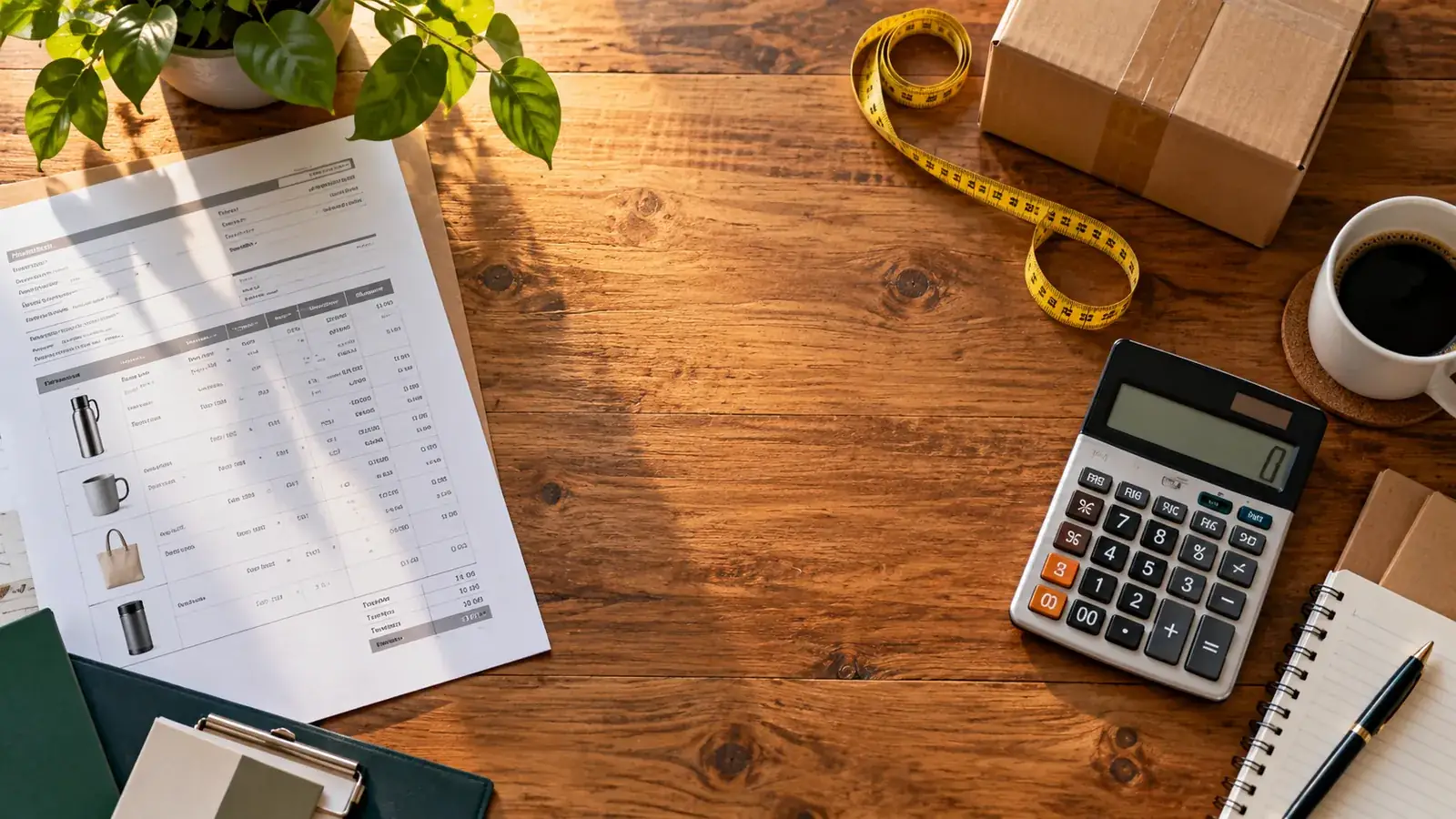
The number that decides your business is not the factory price, it is the landed cost: everything you pay to get one sellable unit to your door. Importers who skip this step discover their real margin after the money is spent. The formula:
Landed cost = product price + inbound freight + duties and taxes + inspection and compliance + payment and service fees (all divided by sellable units, always accounting for the defect allowance you will discard).
A realistic worked example for a small first order, 1,000 units of a $2.00 FOB home-goods product shipped by sea:
| Cost line | Typical amount |
|---|---|
| Product, 1,000 pcs @ $2.00 | $2,000 |
| Sea freight, consolidated share | $300?500 |
| Duties and taxes (varies by market and HS code) | ~5?20% of value |
| Pre-shipment inspection | $280 |
| Agent service fee (if used) | ~8% of product cost |
That lands at roughly $2.60?2.90 per unit, a 30?45% uplift over the factory price. As a planning rule of thumb, multiply FOB by 1.3?1.6 and you will rarely be surprised. The exact freight component moves with mode, our shipping comparison guide covers air, sea, rail, and express, and the service-fee component is explained transparently in sourcing commissions explained. If a supplier’s quote leaves the duty and freight lines vague, that vagueness is the risk, not the number.
Stage 3: Find and verify suppliers
You have two serious sourcing channels in 2027, and experienced importers use both:
Alibaba.com, the export platform, with English support, Trade Assurance payment protection, and verification layers (Verified Supplier status, transaction history, response metrics). It is the right first contact for most overseas buyers. The full verification routine, search filters, business-license checks, certificate verification, RFQ testing, samples, is in our Alibaba supplier guide for 2027 practice. The short version: filter hard, read the business license, message 5?8 suppliers with one identical RFQ, and let the structured replies sort your shortlist.
1688.com. Alibaba Group’s domestic platform, where the same factories sell 30?50% cheaper without export services. Foreign buyers cannot practically transact there alone (Chinese payment rails, no protection, domestic shipping), so the standard route is a sourcing agent who buys as the local buyer of record. When that trade-off makes sense, and the exact five-step agent buying process, are in our 1688 vs Alibaba comparison.
Whoever you shortlist, verify the same three things: the business license is real and matches the account, the company is a genuine manufacturer of your product type (not a trading company wearing the label), and claimed certificates exist with verifiable numbers. A supplier who resists these checks has answered your question, just not in words.
Stage 4: Audit the factory before the deposit
For first orders above a few thousand dollars, custom manufacturing, or regulated categories, an on-site factory audit is the standard control, an inspector spends a day at the facility verifying licenses, machines, real capacity against your order size, QC practices, and working conditions, then delivers a photo-documented report with a risk rating. It costs a few hundred dollars against an order that costs thousands; it is the highest-return spend in the entire chain.
What audits catch, in practice: the “500-worker plant” with two running lines, trading companies dressed as factories, borrowed quality certificates, and capacity that exists only in the quotation. What an audit does not do is guarantee this shipment’s quality, that is Stage 7’s job. The complete walkthrough of audit types, audit day, and report reading is in factory audit explained, and it is standard within our manufacturing and factory management service.
Stage 5: Sample until the spec is real
Order samples from 2?3 shortlisted suppliers, $30?80 with courier, the cheapest insurance in importing. Test them like a customer: daily use for a week, stress the failure points, weigh and measure against spec, then compare all finalists side by side. The differences that drive returns never show in listing photos.
The sample’s deeper job is to become your written specification: materials by name, dimensions with tolerances, colors by Pantone code, weight per unit, logo method, packaging exact. Every item that stays verbal is a defect you invited. Vague specs do not give factories flexibility, they give factories permission to choose, and factories choose in their own interest. This is also the stage where your defect list is born: the written catalog of what counts as critical, major, and minor for your product, which Stage 7 turns into an enforceable inspection standard.
Stage 6: Order with a contract and structured payment
The professional order structure is boring and protective: a signed purchase contract carrying your full specification; payment split 30% deposit / 70% balance after inspection; and all specifications living inside the contract (or a signed annex), not in a chat thread. On Alibaba this structure runs through Trade Assurance, which holds your payment and arbitrates off-spec or late shipments in English. Never wire to a personal account, whoever asks, that single rule removes the largest fraud category in cross-border trade.
The 30/70 split is leverage, not tradition: the deposit funds materials, and the unpaid balance is what makes the factory care about your inspection result. Buyers who pay 100% upfront have converted every subsequent quality conversation into a favor they are requesting. The sourcing agent relationship formalizes all of this, a buyer-paid agent negotiates the contract, holds your spec, and manages the money flow with the factory. What that costs, and how fees stay transparent, is in how commissions work and our published pricing.
Stage 7: Inspect before the goods leave China
This is the stage that separates professional importing from hope. Samples prove a factory can make your product; only inspection proves this batch did. The standard framework is AQL sampling (ISO 2859-1): for a 5,000-unit order, roughly 200 units are pulled at random from the finished, packed goods and checked against your defect list, with the lot passing or failing on published accept/reject numbers, critical defects at zero tolerance, majors typically at AQL 2.5, minors at 4.0. The full mechanics, level choices, and worked examples are in our AQL inspection guide.
The pre-shipment inspection (PSI) is the checkpoint that matters: run when 80?100% of the order is finished and packed, so the sample represents the shipment you are about to pay for. Sequence it before the balance payment, produce, inspect, pass, pay, ship. New products and high-value goods justify 100% sorting ($0.10?0.50 per unit) instead of sampling. When a lot fails, the report’s photos and counts are what make the factory rework at their cost rather than argue, the paperwork from Stage 5 and 6 doing its job.
Stage 8: Ship and clear customs
Freight is a mode-choice decision, not a commodity: express (3?5 days, samples and emergencies), air (5?10 days, urgent and light), rail (15?20 days, EU middle ground), sea (15?35 days, everything planned). Sea is where margins live at volume, the per-kilogram gap versus air is enormous, and it rewards importers who order against a calendar. The mode-by-mode breakdown, volumetric weight, and DDP-vs-FOB terms are in our China shipping comparison; FBA-specific prep and labeling rules are in the Amazon FBA shipping guide.
Customs runs on three documents, commercial invoice (with correct HS codes), packing list, and bill of lading or airway bill, and one honest principle: declare realistically. Under-declaring to save duty risks penalties and seizure, and misclassification, not freight, is the most expensive paperwork mistake in importing. Duties are your HS code’s rate ? declared value, plus VAT/sales tax in most markets; for US imports from China, check Section 301 exposure for your code. Two planning events dominate the calendar: Q4, when Amazon receiving and freight capacity both clog, and Chinese New Year, when factories close for 2?4 weeks and freight spikes, order around them, never into them.
Stage 9: Receive, check, and sell
Even at arrival, verification continues: count cartons against the packing list, photograph anything damaged before signing, and reconcile quantities against the inspection report. For FBA sellers, inventory is not sellable until it checks in, which stretches badly in Q4, so your reorder trigger is a date on the calendar, not a low-stock warning. The sellers who grow are the ones whose second order is already scheduled before the first container lands; the process you just read compresses with repetition, reorders skip most of the risk controls’ cost because the factory is proven and the spec is signed.
Which other channels are worth knowing?
Beyond the two big platforms: trade fairs (Canton Fair in Guangzhou, the largest; fairs for electronics, gifts, and textiles run on annual cycles) put you face-to-face with export-ready factories in days, valuable at scale, expensive as a first step. Industry clusters matter more than listings: sourcing agent networks work from known factory geographies, Shenzhen and Dongguan for electronics, Ningbo and Cixi for home goods and appliances, Yiwu for low-ticket variety goods, Guangzhou and the textile belt for apparel, because the supplier ecosystem, materials markets, and accessory vendors concentrate there. A factory inside the right cluster sources components in hours; the wrong-cluster quote hides freight, minimums, and lead time you did not plan for. This geographic knowledge is one of the quiet reasons a local sourcing agent changes outcomes rather than just translating them.
How long does importing from China take?
| Stage | Typical duration |
|---|---|
| Product research and legality check | 1?2 weeks |
| Supplier search and verification | 2?4 weeks |
| Sampling rounds | 2?4 weeks |
| Production | 3?6 weeks |
| Inspection and prep | 3?7 days |
| Shipping (sea / air) | 1?5 weeks |
| Customs and delivery | 3?10 days |
Plan 3?4 months from idea to live inventory for a first order. Every stage above compresses on reorders, proven suppliers, signed specs, and existing packaging drop the timeline to production plus freight.
What it costs to start importing
Honest budget bands for a careful first run: samples and research, $100?500; a first production order, $1,000?5,000 (small but real, enough for a factory to take you seriously); inspection and audit, $400?600; freight by sea, a few hundred dollars for LCL volumes. Total first-cycle commitment: commonly $2,000?6,000 landed. Below that range you are testing samples, not importing; far above it on a first order, you are concentrating risk before the process has proven itself. The costs scale sub-linearly from here, verification spends once, while product and freight costs fall with volume.
Which mistakes cost first-time importers money?
- Pricing the product, not the landed cost, the freight-duty-inspection stack changes the margin math entirely (Stage 2).
- Paying 100% upfront, removing your only leverage over quality and delivery (Stage 6).
- Trusting the sample instead of inspecting production, samples are handmade; batches are machines (Stage 7).
- Vague specifications, every unspecified attribute is a decision you gave the factory (Stage 5).
- Ordering into Chinese New Year or Q4, the two calendar events that break unbuffered plans every year (Stage 8).
- Choosing suppliers on price alone, the cheapest listing is priced that way for a reason you will meet as a defect (Stage 3).
When to use a sourcing agent
You can run this entire process yourself from overseas, thousands of importers do, especially for simple stock products on Alibaba with Trade Assurance. An agent earns their fee when the chain needs hands in China: 1688-level pricing, factory audits and production follow-up, inspection with photo reports, consolidation of multiple suppliers, FBA prep, and one accountable party from RFQ to delivery. The candidate evaluation is its own discipline, our 10-point agent checklist and how to choose a sourcing agent cover it, and the alignment question is always the same: who pays the agent? A buyer-paid agent has one incentive, your goods correct and your cost down.
We run this exact chain daily from Shenzhen, sourcing, quality control, and shipping for importers, with published fees and named factories on every quote. If you would rather import than manage imports, send us your product idea and we will come back with verified options and an itemized quote.
FAQ
Do I need a license to import from China?
In most markets you import as a business entity with a tax registration (an EIN in the US, an EORI number in the EU), and specific products add licenses or permits, food, cosmetics, electronics with radio functions, and children’s products are the common regulated categories. The product determines the paperwork more than the country does; check your category before ordering, not at the port.
How much money do I need to start?
A careful first cycle, samples, small production order, inspection, sea freight, is realistic at $2,000?6,000 landed. Starting smaller than that buys samples and education, not inventory; starting much larger concentrates risk before the process has proven itself.
Can I import from China without visiting?
Yes, verification travels by proxy: business-license registry checks, live video tours, third-party audits and inspections with photo reports. What you cannot skip is verification itself; you can only choose who performs it, you, remotely, or a qualified person on the ground.
What is the minimum order quantity?
Stock products often start at 1?10 pieces on 1688 and 100?1,000+ on Alibaba; custom products carry production MOQs (a few hundred units and up) on any platform because the factory is funding tooling for you alone. The MOQ mechanics are in the platform comparison.
How do I pay a Chinese factory safely?
Through Trade Assurance on Alibaba, or through an agent who pays locally on your behalf, always 30/70 with the balance gated on inspection, always to a company account, never to a personal one, and never off-platform because someone offered a discount for it.
Will my goods get stuck in customs?
Routine shipments clear in days. Holds happen for misclassified HS codes, undervalued invoices, missing product certificates, or random inspection, all of which are paperwork problems created before shipping. Correct classification and honest declarations are cheaper than any customs problem they prevent.
Is importing from China still worth it in 2027?
Yes, China’s factory depth and price levels remain unmatched for most consumer categories, and the risk-control infrastructure (verification, inspection, escrowed payment, consolidated freight) is now mature enough that careful small buyers get the same protections that used to belong to large ones. The winners are not the people who found the cheapest listing; they are the people who ran the process.
Should my first order be one product or several?
One product, ordered well. Multi-SKU first orders multiply every risk control, several factories, several specs, several inspections, before you have run the process once. Prove one product end-to-end; the second product reuses everything the first one taught you.
Do I need an agent, or can I do all of this alone?
Both paths are real. Alone works for stock products on Alibaba under Trade Assurance when you have time to run the verification steps yourself. An agent earns the fee when the order is custom, multi-supplier, high-value, or time-critical, the sections above mark where that line sits for each stage.
Related guides
- How to find reliable suppliers on Alibaba (2026)
- 1688 vs Alibaba: which should you buy from?
- Factory audit in China: what it covers
- AQL inspection guide: sampling rules
- Private label sourcing from China: starter guide
- Amazon FBA shipping from China
- Shipping from China compared: air, sea, rail, express
- Sourcing agent commissions explained
- China sourcing agent checklist
- Dropshipping from China with an agent
Written by the Yinhan Sourcing team, sourcing agents in Shenzhen running this process, stage by stage, for importers worldwide.