
- What actually moves prices
- Which mistakes raise your price?
- What does a step-by-step RFQ approach look like?
- How much can you actually negotiate the price?
- What levers move the price besides volume?
- When does pushing on price backfire?
- How do you negotiate without damaging the relationship?
- What role does an agent play in negotiation?
- Should you reveal your target price?
- FAQ
- Related guides
Sourcing Guides · 2026 · 8 min read
Negotiating with Chinese suppliers works differently from Western haggling: it runs on volume, predictability and face, not on bluff and pressure. The buyers who consistently get good prices are not the toughest talkers; they are the ones who give factories reasons to invest in the relationship. This guide covers what actually moves prices, the mistakes that quietly raise them, and a step-by-step approach for your next RFQ round.
- First quotes typically carry 10?30% of negotiating room depending on category and volume.
- Hard is fine; disrespectful is not.
- At volume milestones, material cost shifts, or annual reviews.
The core principle first: a factory’s price reflects what producing your order costs them, plus a margin for the risk you represent. You lower prices sustainably by lowering their cost or their risk. You “win” a price by squeezing margin, and the factory quietly recovers it in materials, tolerance or QC. Every tactic below follows from that principle.
What actually moves prices
1. Order volume, real or committed
The strongest lever. “We are testing two SKUs this quarter; the winner reorders monthly at triple volume” is a position factories respond to, because reorders are where their profit lives. Vague promises (“we will order a lot”) read as noise; specific, staged commitments read as a plan.
2. Spec flexibility where it is cheap
Many price gaps hide in details the buyer never actually cared about: a standard color instead of custom-dyed, a stock gauge instead of a custom one, packaging that fits existing tooling. Ask which spec points drive cost; factories will tell you when the question is genuine, and the savings are permanent.
3. Fewer moving parts for them
Mixed-SKU orders, tight deadlines and custom everything all carry surcharges, sometimes unquoted. Consolidating SKUs, relaxing a deadline by a week, or accepting a factory’s standard carton reduces their cost of serving you. That reduction is negotiable currency.
4. Payment structure
Faster payment or a healthier deposit split is worth real money to a factory’s cash flow, and cash flow is what makes their world go round. A buyer offering 40/60 instead of 30/70, or confirmed payment on inspection day, earns a better unit price than one demanding 100% credit. Our payment terms guide covers the safe structures.
Which mistakes raise your price?
- Repeating “give me your best price” without new information. Each repetition tells the factory you have no plan, and the answer is either silence or a price with quality removed.
- Anchoring absurdly low. A counter at 50% of quote ends the conversation politely; factories simply stop taking you seriously.
- Squeezing the last cent. The factory hits your number by downgrading something invisible: wall thickness, coating, gauge. The defect arrives with the goods.
- Negotiating only on price when MOQ, lead time, packaging or payment terms are often easier wins with bigger landed-cost impact.
What does a step-by-step RFQ approach look like?
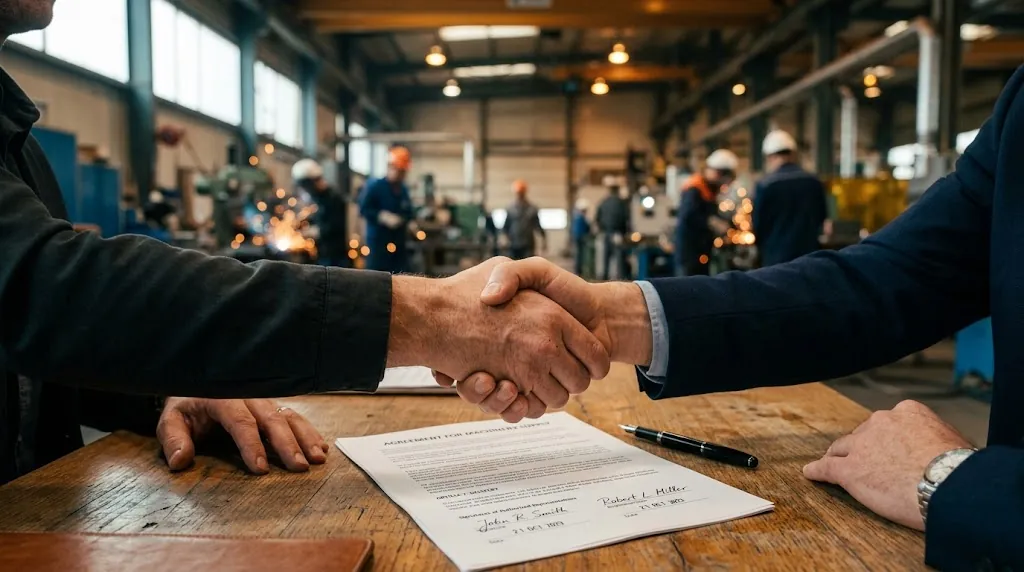
- Step 1: Send the same detailed RFQ to 5?8 qualified factories (see our supplier verification guide for the filtering that comes first).
- Step 2: Score the quotes on unit price, terms and quality signals, then pick the top 3 to negotiate with.
- Step 3: Share your real volume plan and ask, specifically: “which spec points can we adjust to reach this price?” Genuine questions get engineering answers.
- Step 4: Negotiate the package, not the number: unit price, MOQ, lead time, payment split, and who pays for samples and tooling.
- Step 5: Put the final package in the contract with the spec attached. An agreement that lives in chat does not survive a production run.
Agents negotiate with advantages buyers cannot replicate: native language, local standing as a repeat buyer, and market data from dozens of similar orders. Where that matters, our team handles negotiation as part of supplier and product sourcing, and the fee economics are in sourcing commissions explained.
How much can you actually negotiate the price?
Honest ranges beat motivational stories. On a standard product the factory has made before, the first quote usually carries 5 to 10 percent of genuine room, sometimes less if the product is a commodity with transparent material costs. On a custom product, the first quote often includes 10 to 15 percent of room because the factory prices uncertainty as well as goods. Beyond that, pressure stops finding savings and starts finding substitutions. If a quote sits far above market with no explanation, the better move is not harder pushing; it is a second and third benchmark quote so you know what the market actually charges. The supplier sourcing process exists precisely to create that comparison.
What levers move the price besides volume?
Volume is the obvious lever, but several others move a quote without a single extra unit committed:
- Specification: every tolerance, finish, and component you do not need is money. Simplify the spec before you argue the price.
- Payment terms: a 30 percent deposit is standard; offering better terms against a passed inspection is worth real money to a factory with cash flow pressure.
- Order commitment: a planned repeat order changes the factory’s math. Ask for the repeat-order price in the same negotiation, in writing.
- MOQ flexibility: factories hold MOQs to protect changeover time. Paying a small surcharge on a smaller first order is often cheaper than buying inventory you cannot sell.
- Packaging: retail-ready packaging adds cost that plain export cartons do not. Quote both and decide with numbers.
When does pushing on price backfire?
The factory never says no. It says yes at a price that quietly fails somewhere else: a thinner material, a lower-grade component, fewer QC hours, or a rushed finish. The failure surfaces weeks later as defects, which cost more than the discount saved. Warning signs that you have pushed past the floor: the price drops instantly without any counter-question about the spec, the lead time stretches unexplained, or the factory stops asking clarifying questions about your product. If you have squeezed a supplier below their workable margin, your order is being subsidized by your own quality. The defect classification guide shows how to make quality measurable so this trade is visible instead of invisible.
How do you negotiate without damaging the relationship?
Chinese factory negotiations work on a longer clock than a single order. Aggressive one-order wins buy you a discount and a place at the back of the attention queue. What builds leverage: honest volumes, realistic deadlines, fast approvals on samples, and payments that arrive on the agreed date. Buyers who are easy to produce for get first claim on production slots when capacity tightens, which is worth more than the last 3 percent of a first quote. Frame price questions around the relationship, in the plain form of where can we get to if this order runs well, and put the agreed numbers in the proforma invoice so they survive staff changes on either side. The payment schedule and its inspection gate belong in the same document, as covered in the payment terms guide.
What role does an agent play in negotiation?
An agent changes the negotiation in three concrete ways. Language: negotiations conducted in Chinese across WeChat move faster and surface details that a translated email round-trip smooths away. Benchmarks: an agent quoting your product across twenty factories knows what the market price actually is, which turns your negotiation from opinion against opinion into fact against opinion. And leverage: a factory that wants the agent’s repeat business across many clients negotiates differently with them than with a one-order buyer, because the relationship value is bigger than any single margin. The buyer’s job is to supply the hard constraints, the target price, the real volume, and the deadline, so the negotiation runs on truth instead of hope.
Should you reveal your target price?
Partially, and carefully. A target price stated as an ultimatum invites a quote engineered to hit the number rather than to make the product. But hiding your economics entirely has its own cost: the factory quotes blind and pads for uncertainty. The middle path works better. Share the range your business case survives in, ask for an itemized quote that breaks out unit price, packaging, and tooling, and negotiate line by line rather than on the total. Itemized quotes expose which component of the price is actually flexible, and they make quality-relevant lines, like material grade and QC hours, visible enough that a discount cannot quietly eat them.
FAQ
How much below the first quote should I expect to land?
First quotes typically carry 10?30% of negotiating room depending on category and volume. If a factory drops far more than that instantly, the first quote was padded or the quality will be, too.
Should I tell the supplier my target price?
Yes, if it is realistic. A stated target filters out factories that cannot reach it and focuses the rest on engineering solutions. An impossible target filters out everyone except the ones you do not want.
Is it rude to negotiate hard in China?
Hard is fine; disrespectful is not. Demanding, threatening and wasting time are what burn relationships. Structured, honest negotiation builds them.
When should I renegotiate an existing price?
At volume milestones, material cost shifts, or annual reviews. Bring data: your order history and current market quotes. Loyalty with evidence moves prices; loyalty with silence does not.
Related guides
- How to find reliable suppliers on Alibaba (2026)
- Payment terms for importing from China
- Sourcing agent commissions explained
- 1688 vs Alibaba: which should you buy from?
Written by the Yinhan Sourcing team: we negotiate in Chinese with factories every working day.