
- Why ship factory-direct to FBA?
- FNSKU or manufacturer barcode: which do you need?
- What belongs on the FBA prep checklist?
- Which freight options run from China to FBA?
- What customs paperwork does FBA freight need?
- What gets an FBA shipment rejected?
- How do you plan the timeline, not just the shipment?
- What does an FBA freight quote actually contain?
- Prep center or agent warehouse?
- FAQ
- Related guides
Shipping & Logistics · 2026 · 11 min read
Shipping factory-direct to Amazon FBA removes a middleman warehouse, cuts days or weeks off restock time, and protects your margin on every unit, but only if the consignment survives Amazon’s receiving rules. One wrong barcode or missing suffocation warning can refuse an entire shipment at the dock. This guide covers the prep requirements, freight options, customs paperwork, timeline planning, and the rejection causes we see most often.
- Yes, and many do, but most factories are unreliable FBA prep partners.
- It moves with fuel, season, and capacity, quoted per shipment, per kg or per CBM.
- Work backwards from your first selling day: Amazon check-in slows in Q4, so add weeks there; production capacity is also tightest then as every seller orders simultaneously.
The core discipline of FBA shipping is simple to state: everything is checkable before dispatch. Barcodes scan or they don’t; cartons meet limits or they don’t; documents match the cargo or they don’t. Every rejection Amazon issues was visible in a warehouse in Shenzhen days earlier, the entire game is running those checks before the container leaves, not after it lands.
Why ship factory-direct to FBA?
The alternative is a double hop: factory ? your warehouse or a third-party prep center ? Amazon. Each hop adds handling fees, packing errors, and delay. Shipping direct removes all of it: goods are prepped to Amazon’s spec at the point of origin, usually the agent’s warehouse, which does FBA prep daily, and arrive with a delivery appointment. For a restocking seller the compounding effects are the point: fewer stockouts, less capital sitting in intermediate warehouses, and no per-unit prep-center markup.
Direct shipping does raise the stakes on quality control. When goods passed through your hands locally, you could catch defects at the prep center. Factory-direct means the inspection happens in China or not at all, which is why professional FBA sellers run pre-shipment inspection on every lot. Our Amazon FBA sourcing page covers how the whole chain fits together.
FNSKU or manufacturer barcode: which do you need?
Before prep, decide the tracking method. FNSKU (Fulfillment Network SKU) is an Amazon-generated barcode unique to your listing, applied as a label on every unit, it keeps your inventory separated from identical products other sellers send in, and it is the standard choice for private label. Manufacturer barcode tracking (the UPC/EAN the factory applies) lets Amazon pool your inventory with identical items from other sellers, faster receive times in some cases, but it mixes your stock with theirs and does not work for all categories.
Most brand-building sellers use FNSKU, which means every unit needs a label applied so it covers any existing factory barcode, applied flat, scannable after warehouse handling. Labels that peel in poly bags, stick to the bag instead of the product, or sit at an angle the scanner rejects are the single most common prep failure, and the one that costs the most, because the consignment is otherwise perfect.
What belongs on the FBA prep checklist?
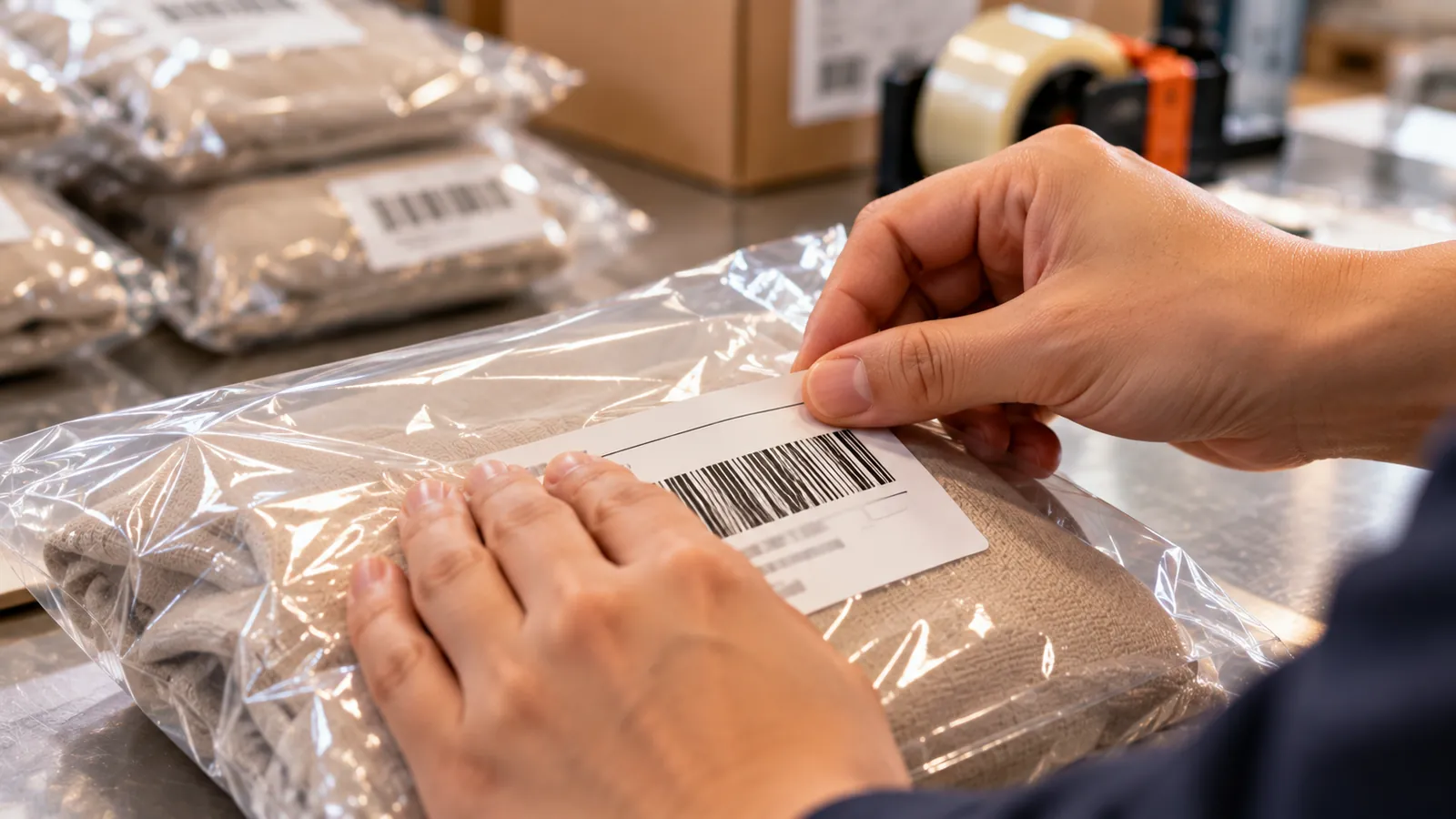
- FNSKU on every unit, covering existing barcodes, flat, scannable, durable through friction and handling.
- Poly bags with suffocation warnings, required for any bagged unit; the printed warning needs a minimum font size (10 pt) and a suffocation pictogram for bags with a 5-inch-plus opening. Bags need a suffocation warning in the destination market’s language.
- Box labels on every carton, the shipment labels Amazon generates, placed flat on the largest side, never across a seam, never on a corner, never wrapped around an edge.
- Compliant cartons, marketplace-specific weight and dimension limits (the US limit is 50 lb per box unless containing a single oversized unit), sturdy boxes, six-sides-tape rule, no overpacking that bulges or bursts under stacking.
- Category-specific prep, liquids need double-bagging and survival testing, batteries need terminal protection and quantity limits, plush needs bagging, sharp products need blunt-proof packaging. Check the category page before production, because some rules (like transparent packaging for toys) affect how the product is manufactured, not just packed.
- Expiration-dated goods, printed expiration dates with at least 105 days of shelf life at arrival, formatted and applied per Amazon’s rules.
Which freight options run from China to FBA?
| Mode | Transit time | Best for | Cost level |
|---|---|---|---|
| Sea freight | 20?35 days door-to-door | Full restocks, heavy or bulky goods | $ (lowest per kg) |
| Air freight | 5?10 days | Mid-size urgent restocks | $$ |
| Express courier | 3?5 days | Small urgent shipments, samples | $$$ |
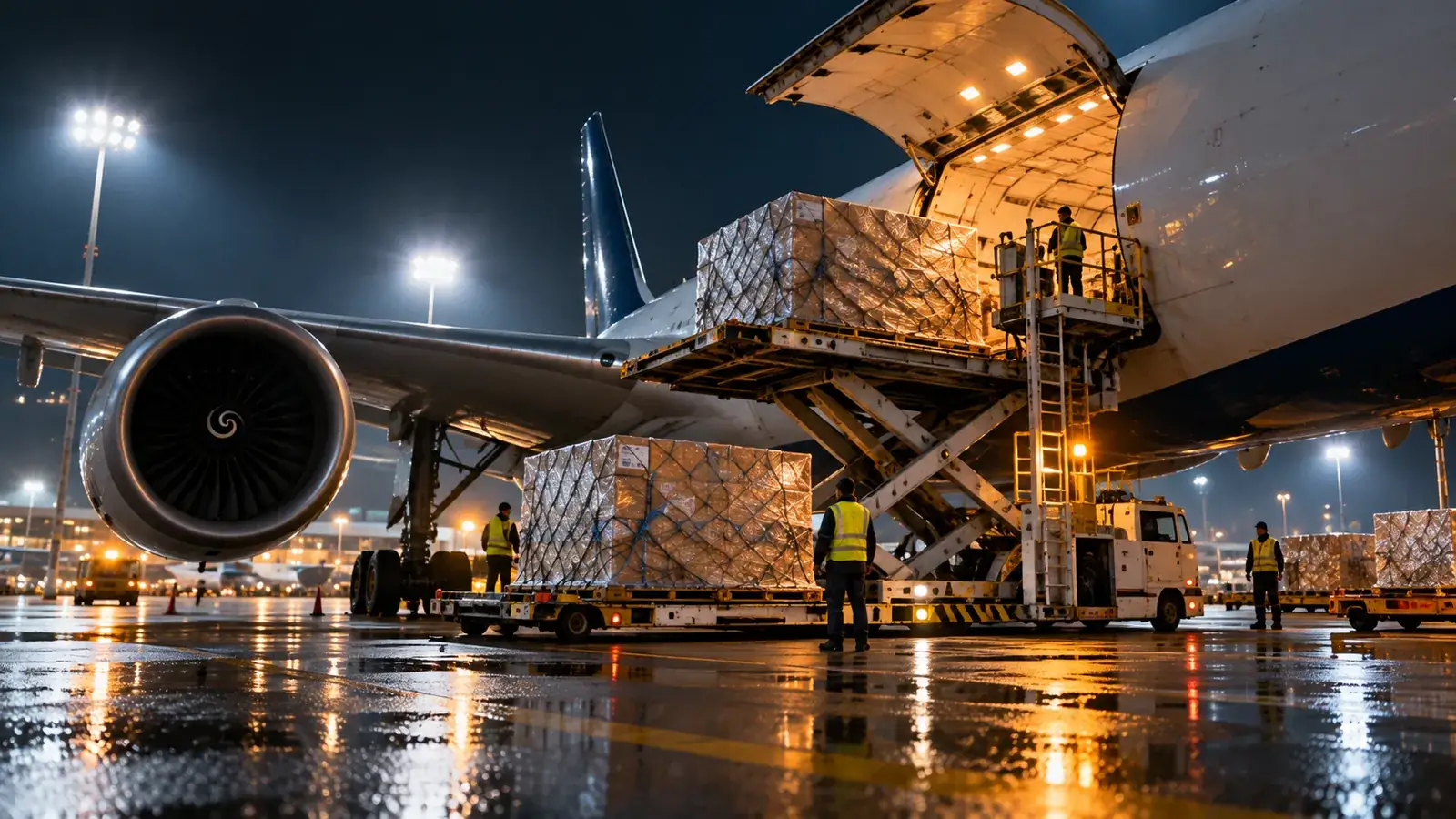
Sea freight is the default for planned restocks, the per-kilogram saving over air is enormous, and the trade-off is planning discipline: you commit inventory to the water weeks before it sells. Air freight covers the middle ground: expensive relative to sea, far below courier rates at scale, and fast enough to rescue a stockout without paying express prices. Express courier (DHL/FedEx/UPS) wins on simplicity, door-to-door in under a week with clearance handled inside the network, and loses on price per kilogram for anything beyond a few boxes.
Two details decide real costs more than the mode headline. Volumetric weight: air and express bill on the greater of actual and dimensional weight, so bulky-light cargo pays for space, packaging efficiency is money. DDP terms: most FBA shipments move delivered-duty-paid, meaning the shipper handles export clearance, import duties, and delivery to the Amazon dock for one all-in rate. Always confirm a quote is DDP including duties, or the saving you calculated meets the customs invoice at the border. Our China shipping comparison guide goes deeper on modes and terms.
What customs paperwork does FBA freight need?
Three documents carry the shipment. The commercial invoice states the goods, values, HS codes, and consignee, and it is the document customs prices your duty from. The packing list details carton-by-carton contents and weights, and it is what receiving teams and inspectors check against. The bill of lading (sea) or airway bill (air) is the transport contract and title document. Your freight forwarder prepares and files these, but they build them from data the factory or agent supplies, wrong declared values or HS codes on the source data become your problem at destination, not theirs.
Two rules keep this clean. First, declare realistically, under-declaring to shrink duty risks penalties, delays, and seizure, and it poisons your own claims ability if cargo is lost. Second, use correct HS codes, misclassification is the most common cause of surprise duty bills, and “we always use this code” from a factory is not classification expertise. For US imports from China, check whether Section 301 tariffs apply to your code and whether your category carries exclusions, the duty difference between adjacent codes can be 25% of value.
What gets an FBA shipment rejected?
- Wrong or missing FNSKU ? scan-test a sample of labels from every carton before dispatch.
- Poly bags without suffocation warnings ? check the bag spec at sample stage, not packing stage.
- Overweight or bulging cartons ? weigh every carton on a calibrated scale during packing; re-pack outliers.
- Labels across seams or corners ? photo-check carton faces after labeling, before container loading.
- Category compliance failures, missing test reports for toys, electronics, food contact ? verify certificates at supplier vetting, months before shipping.
- Quantity mismatches, carton counts in the system don’t match physical reality ? count during container loading, and photo-document the load.
Notice the pattern: every rejection cause is a five-minute check at the right moment. A pre-shipment AQL inspection plus a carton-level FBA compliance check costs a few hundred dollars; a refused container at a US port costs the selling season.
How do you plan the timeline, not just the shipment?
Work backwards from your stockout date, and budget every stage: production lead time (20?45 days for custom orders), inland transport to port, ocean transit plus customs, Amazon’s receiving and check-in time, which stretches badly in Q4, and buffer for the one thing that always happens. Sellers who order “when stock gets low” are betting the whole chain runs perfectly; professionals order against a calendar with slack in it.
One calendar event dominates Chinese shipping: Chinese New Year. Factories shut for 2?4 weeks, and freight capacity tightens and spikes in price in the weeks before and after as everyone rushes cargo. Restock plans that ignore CNY fail every January, either goods stuck behind a factory shutdown or premiums paid for panic freight. Book production to finish before the shutdown or start right after it, and add buffer either side.
We run this end-to-end: production monitoring, 1-by-1 or AQL inspection, FNSKU labeling and FBA prep in our Shenzhen warehouse, then DDP freight straight to Amazon, see how our process works and case studies for real examples.
What does an FBA freight quote actually contain?
A DDP quote to FBA bundles six cost lines into one number: origin charges (factory pickup, warehouse handling, export customs in China), main-leg freight (vessel or aircraft), import clearance at destination, duties and taxes, delivery to the fulfillment center with an appointment, and the forwarder’s margin. Two quotes can differ by 30% and be identical in substance, or identical in substance and differ by 30% in what they quietly exclude. The classic trap is a cheap quote that stops at the port: goods arrive, and destination charges, duties, and delivery get billed separately at full price.
When comparing forwarders or agent-inclusive quotes, ask three questions. Is this quote DDP all the way to the Amazon dock, or does responsibility end earlier? Are duties estimated or billed at cost with the actual customs invoice attached? And what happens on delay, who pays demurrage if the container sits at port past free time? The answers tell you whether you are comparing freight or comparing invoices that have not arrived yet.
Prep center or agent warehouse?
US-based prep centers solve the same labeling problem closer to home, at $1?3 per unit plus inbound freight to their dock. An agent’s warehouse in China does the same work before export, inspection and prep happen in one place, the goods ship once instead of twice, and you skip the US inbound leg entirely. The crossover is product value and urgency: local prep makes sense for high-value goods where you want domestic returns handling; origin prep wins on cost for everything that ships by sea anyway. What never makes sense is prep as an afterthought, whatever does the prep, it is a checkpoint with a name on it, not a favor from the factory.
Do I need a freight forwarder if my supplier quotes FOB?
FOB means the supplier covers nothing after the goods load at their port, freight, insurance, import clearance, duties, and delivery are all yours. You can book that yourself with a forwarder, or hand the whole post-factory chain to an agent who consolidates and manages it. What you should not do is let the gaps go unassigned: every leg without a named responsible party is a delay waiting for a schedule.
How long does Amazon take to check in a shipment?
Typically a few days in normal seasons, and one to two weeks or more in Q4, when receiving docks are saturated. Factor check-in into your reorder math, because inventory is not sellable until it shows live, and a container “delivered” during peak can still miss your selling window.
New to the whole process? Start with the complete guide to importing from China, which maps every stage this guide touches, with costs and timelines.
FAQ
Can my supplier ship directly to Amazon?
Yes, and many do, but most factories are unreliable FBA prep partners. Labeling errors and non-compliant packing are routine when prep is a side task on a production floor. An agent or forwarder doing FBA prep daily is the safer route, and inspection happens before dispatch either way.
Should I use FNSKU or manufacturer barcode tracking?
FNSKU if you are building a brand or the product is in a category with commingling risk; manufacturer barcode only when speed matters more than inventory separation and your category allows it. Most private label sellers stay on FNSKU permanently.
How much does shipping from China to FBA cost?
It moves with fuel, season, and capacity, quoted per shipment, per kg or per CBM. Sea is a fraction of air; air is a fraction of express. Get the DDP quote including duties so you compare true landed cost, and re-quote every season rather than assuming last quarter’s rate.
When should I order production before Q4?
Work backwards from your first selling day: Amazon check-in slows in Q4, so add weeks there; production capacity is also tightest then as every seller orders simultaneously. Most Q4 sellers start production in July?August for sea freight. Ordering later is possible with air freight, at air freight prices.
Do I need cargo insurance?
For sea freight on meaningful orders, yes, marine cargo insurance costs a fraction of a percent of cargo value and covers what carrier liability does not. Check the forwarder’s liability terms before assuming you are covered; standard carrier liability is usually a tiny fraction of cargo value.
Related guides
- Shipping from China compared: air, sea, rail, express
- AQL inspection guide: sampling rules
- How to find reliable suppliers on Alibaba (2026)
- Private label sourcing from China: starter guide
- Air fryer and juicer sourcing guide
Written by the Yinhan Sourcing team, sourcing agents in Shenzhen running FBA prep and DDP freight for sellers every week.