- What does the first-article inspection approve?
- How does DUPRO catch drift during production?
- Why is the pre-shipment inspection the gate that matters?
- How does the container loading check prove what ships?
- Which checkpoints does your order need?
- How does AQL sampling work in plain numbers?
- What inspections cost and how to schedule them
- When an inspection fails, what then?
- Can you skip inspections if the factory has its own QC?
- FAQ
- Related guides
Quality Control · 2026 · 9 min read
Product inspection in China is not one service but a sequence of checkpoints, each with a different job: first-article inspection approves how production starts, during-production checks (DUPRO) catch systematic errors mid-run, pre-shipment inspection (PSI) gates the finished lot before your balance payment, and a container loading check proves the right goods went into the box. This guide explains what each type covers, when to use it, and how they fit one order’s timeline.
- During Production inspection: a quality check run while the order is still being manufactured, typically at 20?50% completion.
- PSI is the timing (when the check happens); AQL is the method (how many units are sampled and what passes).
- For consolidated orders or factories you do not fully trust yet, yes: the loading check verifies that the passed goods are the ones that actually ship.
The core idea: every checkpoint exists because a certain class of mistake is cheapest to catch at that moment. Wrong material is cheapest to catch at first article, a drifting process is cheapest mid-run, a bad finished lot is cheapest before shipment, and a loading error is cheapest at the container door. Skipping a checkpoint does not remove the mistake class; it moves the cost downstream.
What does the first-article inspection approve?
Run when the first production units come off the line. The inspector checks them against your spec: materials, dimensions, color, logo placement, packaging. If the first articles are wrong, the factory corrects before producing 5,000 wrong units. This is the cheapest checkpoint in the chain and the most commonly skipped, usually by buyers who trust the approved sample too much. Samples are handmade; production is machines and shifts.
How does DUPRO catch drift during production?
During-production inspection runs when roughly 20?50% of the order is complete. Its job is different from the others: not to judge the finished goods, but to answer whether the process is under control. Are the right materials still being used? Has the line drifted on tolerance? Are workers following the packaging spec? A DUPRO finding gives the factory time to correct the remaining 50?80% of the order, which is why it is the checkpoint that most often saves a delivery date.
Choose DUPRO for long production runs, complex products, new factories, or orders where a late failure would be catastrophic. For short, simple runs it is optional; the PSI covers the risk.
Why is the pre-shipment inspection the gate that matters?
PSI runs when 80?100% of the order is finished and packed, and it is the checkpoint your payment terms should be built around. The inspector pulls a statistically valid sample (AQL sampling per ISO 2859-1), checks it against your written defect list, sorts findings into critical, major and minor, and issues a pass or fail with photo evidence. Balance payment follows a pass, not the other way around.
What PSI catches: finished-goods defects, wrong variants or quantities, packaging and labeling errors, and carton problems. What it cannot catch: defects hiding in the uninspected units. When the stakes justify certainty, replace sampling with 1-by-1 inspection ($0.10?0.50 per unit) for the batch.
How does the container loading check prove what ships?
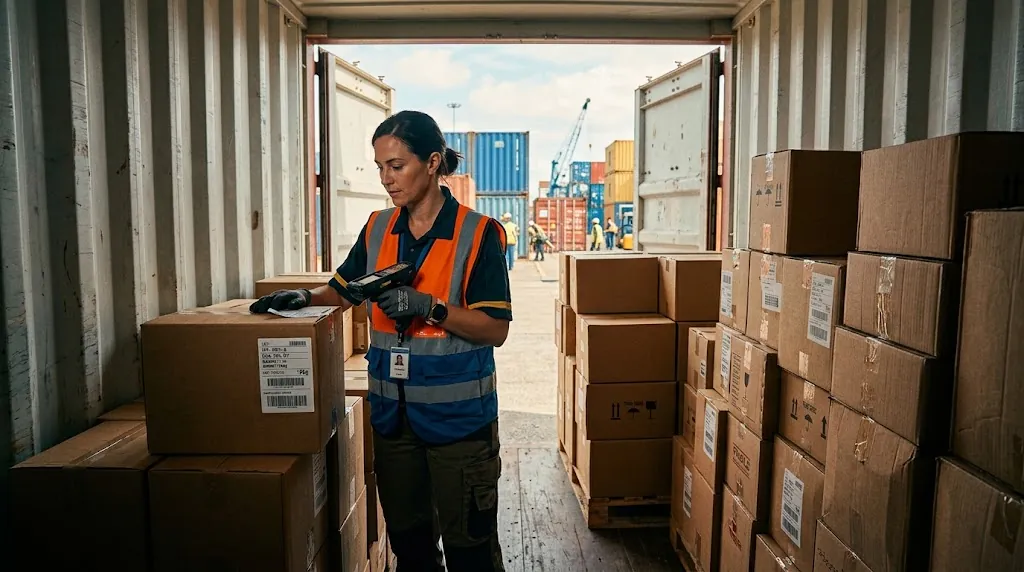
The final checkpoint happens at the container door: right goods, right quantities, right carton condition, loaded the way the plan says, documented with photos and a count. It exists because a passed PSI does not physically prevent a factory from loading rejected stock, substituting goods, or double-stacking cartons that crush. For consolidated orders the loading check also verifies which supplier’s goods went where.
Which checkpoints does your order need?
| Order situation | Recommended checkpoints |
|---|---|
| Simple stock reorder, proven factory | PSI |
| New product, new factory | First article + PSI (consider 1-by-1) |
| Long or complex production run | First article + DUPRO + PSI |
| High-value or safety-critical goods | First article + DUPRO + 1-by-1 + loading check |
| Multi-supplier consolidated order | PSI per supplier + loading check at consolidation |
The sequence scales with risk, not with budget: the base case is always a PSI, and every additional checkpoint buys protection against a specific failure class. Costs are per man-day or per unit, small against the value they protect. Our manufacturing and factory management service bundles these gates into the production plan.
How does AQL sampling work in plain numbers?
Pre-shipment inspection is built on a statistical method called AQL, which stands for Acceptable Quality Limit. The idea is simple: you cannot check 1,200 units one by one in a day, so the inspector checks a sample whose size is big enough to represent the whole batch. The standard used is ISO 2859-1, known in China as GB/T 2828.1, and it defines both the sample size and the number of defects that pass or fail the lot.
Here is what it looks like on a real order. You have 1,200 units finished and packed. Under inspection level II, the sample size is 80 units. At the widely used standard of AQL 2.5 for major defects, the lot passes if the inspector finds 5 or fewer major defects in those 80 units, and fails at 6 or more. Critical defects, meaning safety issues or legal problems such as a missing warning label, carry zero tolerance: a single one fails the inspection. Minor defects, like a small scratch that does not affect use, usually run at AQL 4.0, so a handful is tolerable.
The numbers matter because they make quality a contract term instead of a feeling. When your supplier signs a checklist that says AQL 2.5, both sides know exactly what failure means. Without it, a factory can honestly say the goods are fine while you look at a 6 percent defect rate and see a return season coming.
What inspections cost and how to schedule them
Third-party inspection in China is charged per inspector-day, around $280 per day including travel and the photo report. One inspector can visually check roughly 1,500 to 2,000 units in a day, so a full-container order almost always fits in a single day. Function testing, carton drop tests, and measuring against the golden sample are included in the fee at most agencies; anything that needs a laboratory, like textile composition or food-contact testing, is quoted separately.
Timing rules of thumb make the calendar easier. Book a pre-shipment inspection three to five working days ahead when you can; most agencies can accept a 48-hour request. The inspection window opens when production is complete and at least 80 percent of the goods are packed, because packed cartons are what actually get sampled and drop tested. A DUPRO check sits at 20 to 50 percent of production complete, and a container loading check is booked for the morning the container arrives. Your inspector needs three things from you: the approved sample photos or reference sample, the checklist of what to verify, and the packing specification. Reports come back within 24 hours, with photos of every defect found.
If you work through a sourcing agent, inspection is usually bundled into the service and scheduled automatically at the right moments. The agent also reads the report with factory context you do not have, which is the difference between a cosmetic issue you accept and a process problem you reject. The commission structure page explains how that folds into the overall cost.
When an inspection fails, what then?
A failed report is leverage, not a disaster, as long as your payment schedule is built for it. The factory has finished goods they cannot ship, and you are holding the balance payment. That combination moves factories fast. The normal sequence looks like this.
- Review the report within a day and separate true rejects from acceptable minors. Mark your decisions directly on the inspector’s photos so there is no ambiguity.
- Ask the factory for a written rework plan: what will be fixed, who pays, and how many days it takes. Defect corrections at this stage are usually the supplier’s cost when the defect is a specification miss.
- Book a re-inspection of the corrected scope only. A full recheck is rarely needed, so some agencies discount the second visit, and factories that caused the failure typically cover it.
- For mixed results, partial acceptance is an option: release the clean cartons, hold the affected ones for rework. Your loading check then verifies only what actually ships.
Realistically, a failed inspection with rework and a re-check adds five to ten days to your timeline. Build that buffer into any promise you have made to customers, and you will never be forced to accept goods you are not happy with. The payment schedule and the inspection plan are two halves of one system, which is why your payment terms should always reference the inspection gate in writing.
Can you skip inspections if the factory has its own QC?
Every serious factory has an internal QC team, and for stable products with mature processes that team does most of the useful work. The catch is incentive. Factory QC reports to the factory, and their job is to ship goods, not to argue with the production line on your behalf. Internal reports rarely include the defect photos, sample counts, and AQL math that a third-party report carries, which makes them weak evidence if a dispute ever reaches a platform or a payment provider.
A practical split: rely on factory QC for repeat orders of a product that has passed inspection three times running, and put third-party eyes back on when anything changes. New supplier, new mold, new packaging line, a different factory wing, or a first order after a long gap all justify starting the checkpoint cycle again. The cost of one inspection day is a rounding error next to a container of unsellable goods, and the report keeps your balance payment decision on facts instead of promises.
FAQ
What does DUPRO stand for?
During Production inspection: a quality check run while the order is still being manufactured, typically at 20?50% completion.
Is pre-shipment inspection the same as AQL?
PSI is the timing (when the check happens); AQL is the method (how many units are sampled and what passes). A PSI almost always uses AQL sampling against your defect list.
Do I need a loading check if the PSI passed?
For consolidated orders or factories you do not fully trust yet, yes: the loading check verifies that the passed goods are the ones that actually ship. It is the only checkpoint that sees the container.
How far in advance should inspections be booked?
Two to three working days’ notice is standard for reachable factory regions. Book alongside production milestones rather than after them, so the inspector arrives exactly when the goods are ready.
Related guides
- AQL inspection guide: sampling rules
- Quality defects classification: critical, major, minor
- Factory audit in China: what it covers
- Amazon FBA shipping from China
- Full-service China sourcing
Written by the Yinhan Sourcing team: our inspectors run all four checkpoint types on factory floors across China every week.